
I wish that the internet, Google and AI had been around in the Sixties. If you wanted to appear as someone with wide-ranging intellectual prowess, you really needed to have seen the film, artwork or play before you could discuss it. I have just made myself familiar with the drama, Miss Julie by Johan August Strindberg, in about fifteen minutes thanks to Wikipedia. I didn’t look it up because I had an attack of the luvvies, but because there was someone very special I was out to impress, and that, my dear reader, was your good self. OK, I’ve blown it now, but the sentiment is there.
The House Party by Laura Lomas, is billed as being ‘after Miss Julie by August Strindberg’ it’s well after really as he died in 1912. He was a member of the ‘naturalism’ movement – no, he wasn’t a nudist, that’s naturism – he thought that plays ought to be written and performed in a natural manner, rather than being structured, and should have a deeper meaning than just telling a story. As a result, Miss Julie, and, therefore, The House Party, are more concerned with the relationships between the characters than the plot. In fact, the ‘plot’ is a situation into which they have been placed in order to reveal the point the writer is trying to make. Nowadays this is common, so we are all familiar with naturalism but don’t realise it.
There is little point in comparing the works side by side as The House Party is firmly set in the 21st Century, probably the early 2010s, as the final scene, which has been added, refers to the main action as having happened ten years ago.
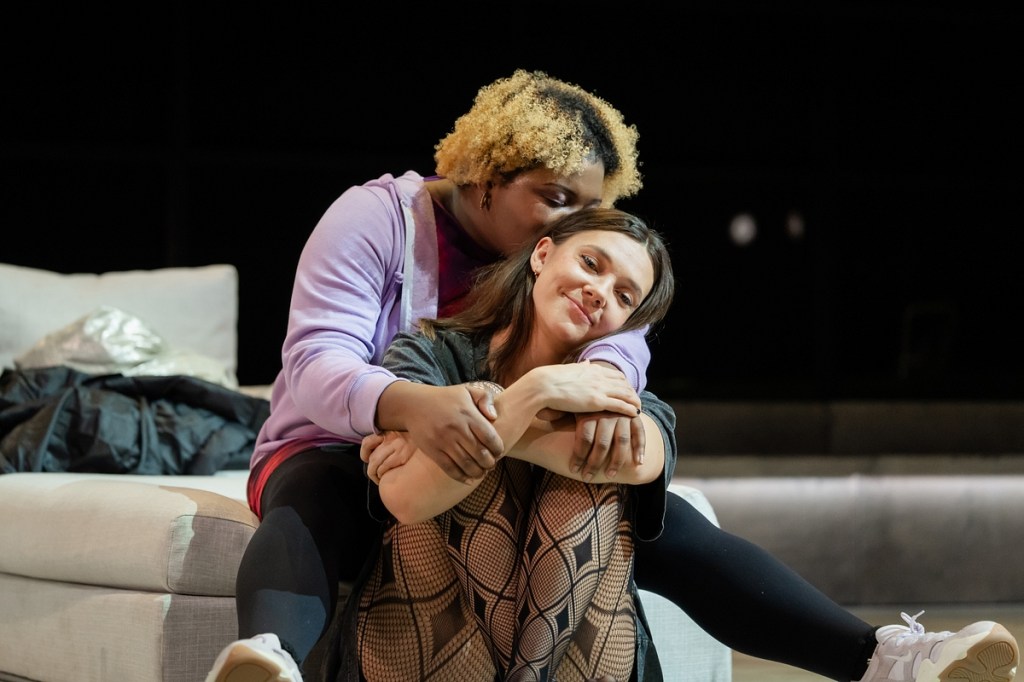
Christine, played by Kelsey Hope, comforts the newly-dumped Julie, Synnøve Karlsen, before the party begins.
The situation is that Julie, played by Synnøve Karlsen, is holding her 18th Birthday Party at the opulent home, where she lives with her father, who is working away, as usual. She is with her bestie, Christine (Selsey Hope), a working class girl of similar age, who has been given an interview for a place at Cambridge University the following day. Julie is all for getting hammered before the party even begins, but Christine needs to stay sober for her big day. Enter the third side of the triangle, Jon, played by Tom Lewis, whose mother used to clean for Julie’s family, and who is an item with Christine. He is not in higher education but working as an intern, however, he is on the brink of being offered a permanent position in the company. All three have known each other since childhood, a phase Julie has seemingly still not grown out of.
The catalyst is that Julie has just had a text to say that she has been dumped by her boyfriend, hence the hitting of the bottle. The action takes place in the huge kitchen whilst the party is in full swing upstairs in the living room. Revellers keep passing through, dancing and cavorting, to illustrate the stage of the bash. There was also a large digital wall clock to keep us abreast of the time, an important factor, in that a deadline of 10.00p.m., later revised to midnight, had been set by Christine as being when she needed to leave with Jon, who was driving her to Cambridge, for her interview.
The three protagonists slowly revealed their deep-seated characteristics. Julie, the spoilt, entitled, rich bitch who had turned into a bully and manipulator, even organising the party at the last minute, knowing that it would test Christine’s loyalty, with her interview scheduled for the following day, was shown to be using these traits to compensate for her being lonely and neglected. Her father was away a lot and her mother had left them some time before for a Scottish builder. She had a recurring dream of being held aloft by a group of people, who would then drop her and kick her whilst she was on the ground. She even felt betrayed by her pet dog, which had become pregnant, treating it with the same disdain she would have had it been an unfaithful boyfriend, even resorting to giving it the ‘morning after’ pill, ground up and added to its food, and later dispatching it!
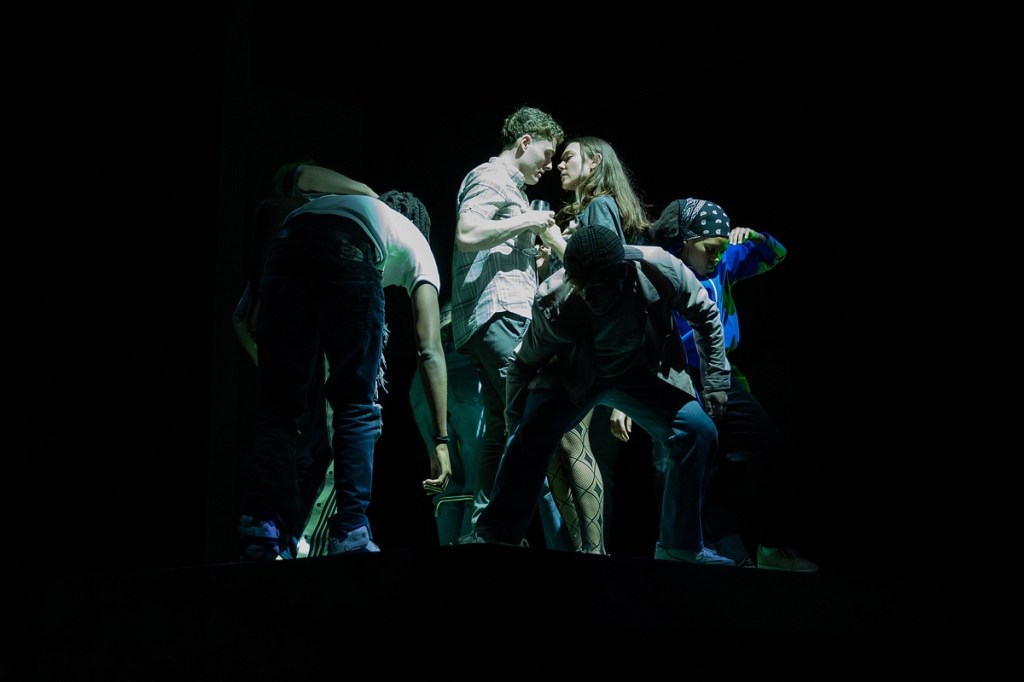
Jon, Tom Lewis, and Julie, Synnøve Karlsen, dirty dancing.
Christine, on the other hand, was grounded and working hard at her studies, even though she had a mother who needed to be cared for on both physical and mental grounds. Her emotions toward Julie were sincere, wanting to help her out as much as she could, in spite of being taken advantage of. She ain’t seen nothin’ yet!
Jon was a social chameleon, prepared to fit in with everyone else’s plans. When Christine was wavering about whether to go away to university with her mother being so dependent on her, he offered to call round and make sure that she was given her medication every day. He was also carrying a flame for Julie from when they were in school together but he was part of a group who spread gossip about her sex life which caused her to have to move schools.
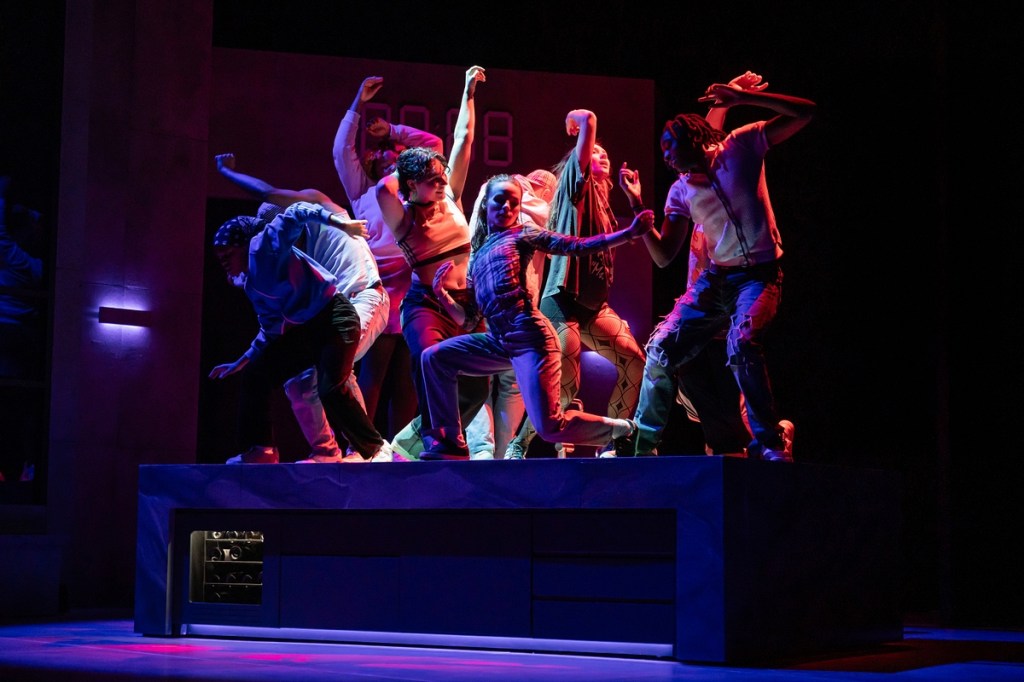
The Frantic Assembly throw their shapes on the kitchen island
As the deadline for Christine’s departure neared – it was obviously never going to be met – she hit the vodka in a big way and needed to go lie down. To me it seemed like something of a relief to her, removing the potential guilt of leaving her mother, as she too, kept having a dream, taking her back to when she was a child. It was also chalked up as a moral, or should that be amoral, victory for Julie, who, now alone with Jon, admitted to having fancied him at school as well. After symbolically opening a bottle of Julie’s father’s very expensive wine, which he had refused to do earlier, citing as reasons both his need to drive Christine, and being uneasy about taking something which belonged to Julie’s father, he succumbed. At this it was Julie who chastised him for the procurement. The taking of something ‘belonging’ to her father didn’t stop there and the two found a novel way of cleaning the worktop of the kitchen island.
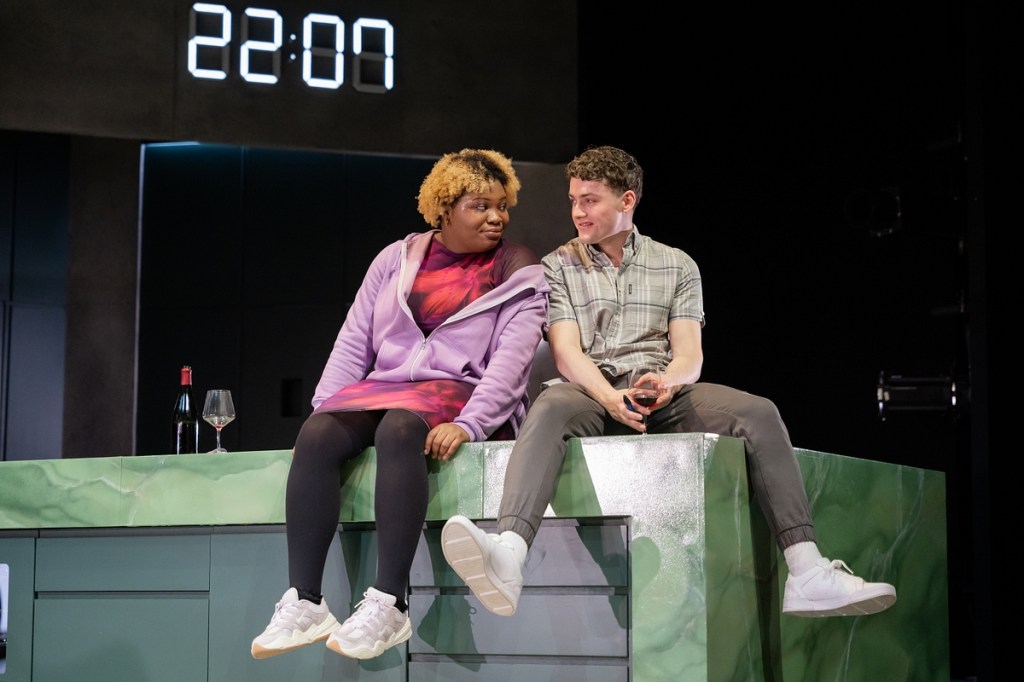
Christine, Kelsey Hope, with boyfriend Jon, Tom Lewis, the 10.00p.m. deadline missed, so changed to midnight.
One of the partygoers had been witness to this, videoed it and posted it on social media, causing the pair to have to fess up to Christine when she returned. This is where things took a dark turn. After an altercation, she mellowed somewhat toward Jon, whilst Julie disappeared upstairs in a mood of deep despair. A few moments later, Christine and Jon realised that the knife with which Julie had sent her mutt to the great kennel in the sky, was missing, and they raced up to her room to see if she was alright.
This is where I must refer back to the original as that play ends with Julie, realising that she has no-one and is basically bereft of any genuine feelings, asking Jon if there was any way out of her despair, at which point he hands her a razor! She walks through a door and the curtain falls.

Kelsey Hope as Christine
In my research, I read that the the play is based on Darwinism, not so much in the physical evolution of the species, but the social progress. The rich falling from power and the poor being more self-assured. The midrange doing whatever was needed to get on. I couldn’t help but think that Strindberg might have been onto something there, not so much in the social hierarchy as in the intellectual development. Laura Lomas obviously felt the need to tie up the loose ends and add a bow, as, after Christine and Tom break into Julie’s room, there is a scene in which an ambulance arrives and takes away an apparently lifeless body, followed by another appendix, ten years later when Julie, obviously fully recovered, bumps into Christine and goes back to her small home for a cup of tea, and to catch up. She meets Christine’s daughter and the status of Jon is revealed. I really don’t understand the motive behind that, the theory of naturalism seems to be that the audience should be stretched and left wondering and speculating as to the fate of the characters concerned after the party.

Tom Lewis as Jon
The acting was phenomenal, the disintegration of Julie, from a not very high start to the lowest of the low, was heart rending, even though she had no redeeming features whatsoever, until the added epilogue. Christine’s resilience, even though she was doomed to not being able to fulfil her potential, was done without a hint of self-pity. Tom, seemingly the donor in a personality transplant, pinballed his way through the evening, being bounced from one situation to another, seemingly just happy to please, until his epiphany.

Synnøve Karlsen as Julie
The play itself was superbly staged, although I wondered at the beginning whether I would be able to maintain my concentration, as it reminded me of a teen programme on BBC3 where everyone speaks really quickly and gestures to excess. Once the scene had been set it settled down into normal conversation and quickly had me hooked.
I realise that I have revealed more than normal but it wasn’t meant to be a thriller, more an exploration of interpersonal relationships based on the characters’ histories and the places in which they found themselves. The incidents during the celebrations were merely tools to expose these.
In addition to the three main characters there was an ensemble, who acted as partygoers, bursting into the kitchen and dancing on the worktop, possibly why it needed to be wiped down! They also acted out the two women’s dreams in compartments at the back of the stage, behind smoked glass.
The set, designed by Loren Elstein, was transformed by the ensemble during the course of the performance, although it took some time to do this on one occasion, when a group of them had to create Christine’s current home on top of the kitchen island. During this process there was a female dancer on the other side of the stage, but my attention was grabbed by the furniture movers, especially as, although in dimmed light, a couple of them had hi-vis jackets on, emblazoned with the word ‘Ambulance’.
The Director was Holly Race Roughan and The House Party is a Leeds Playhouse Presentation of a Chichester Festival Theatre and Headlong co-production in association with Frantic Assembly.
Photographs by Ikin Yum
The House Party runs at Leeds Playhouse until 1st March, 2025 after which it tours to Rose Theatre, London, 4th – 22nd March, HOME Manchester, 24th – 29th March, Bristol Old Vic, 23rd April – 3rd May, ending at Belgrade Theatre 6th – 10th May.
To book, please go to https://www.cft.org.uk/events/the-house-party-tour
For details of other shows at Leeds Playhouse please see https://www.leedsplayhouse.org.uk/whats-on/
Whilst writing and referring to Wiki for the original ending, I had the most frightening thought, I was born 14 years nearer the premier of the original production in 1889, than that of the current one in 2024! That could explain everything. Even though of a different era, I enjoyed the evening immensely and would recommend you see it when it tours.

